
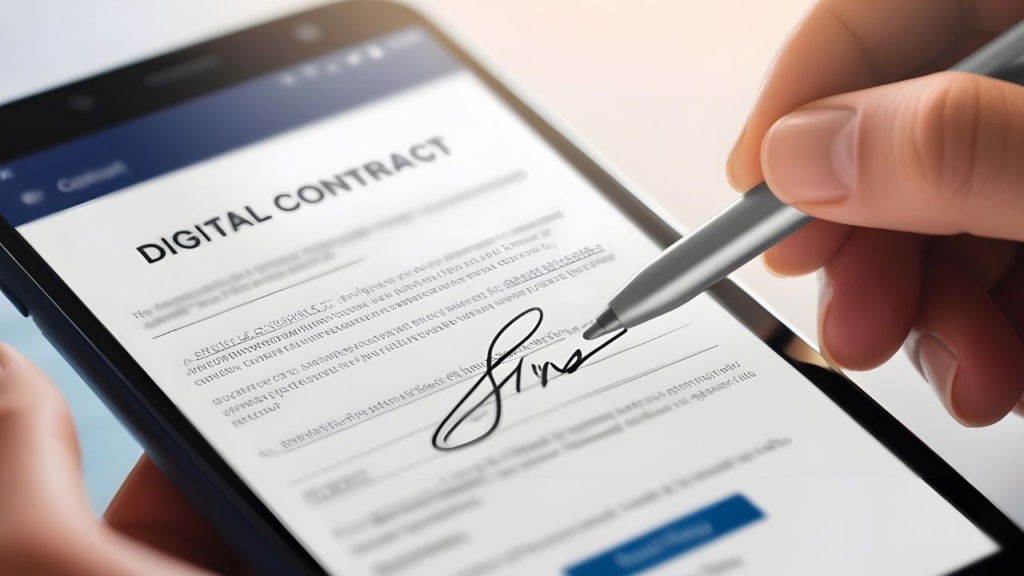
There are no specific / stringent laws and legislations to govern E-contracts in India which brings a whole set of difficulties and legal issues. Nonetheless, there is some legislation which has to be read and referred together to attach validity to E-contracts. These laws are as follows:
The Indian Contract Act, 1872
The Indian Contract Act 1872 governs all contracts and regulates the ways in which contracts are formed and enacted in India. Hence, every agreement formed is required to fulfil the requirements laid down under this law to enforce it legally[1]. As per the ICA, even if electronic means are used to form a contract, that contract will be considered enforceable and valid[2].
Section 2(h) of the Indian Contract Act 1872 defines what constitutes a valid contract[3]. The essential conditions for an agreement to become a legitimate contract and persons competent to contract are laid out in Sections 10 and 11 of the Indian contract, respectively[4]. Sections 23 and 25 define the terms “lawful object” and “lawful consideration,” respectively[5]. All of the provisions of the Indian Contract Act, 1872, apply equally to electronic contracts.
The Information Technology Act, 2000
The Indian Contract Act covers provisions regarding Contracts but it fails to mention anything about E-contracts’ legitimacy[6]. The IT Act, 2000 saves the day in this light to some extent. The Information Technology Act of 2000, or IT Act, aims to grant legal recognition to a transaction carried out through electronic means, or “electronic commerce,” as it is commonly known[7]. The Information Technology Act of 2000 established legal recognition for electronic exchanges and transactions as all electronic agreements would be considered completely legal.
Section 3 of the IT Act:
The verification of electronic contracts is affirmed by both parties by attaching electronic signatures to them, according to Section 3 of the IT Act, 2000[8]. Electronic record confirmation by electronic signature or electronic validation method will be regarded as reliable that can form a strong basis for launching litigation in a court of law[9]. In this way, advanced marks can be used to create an electronic agreement that is recognized by Indian laws[10]
Section 4 of the IT Act:
According to Section 4 of the IT Act, 2000 any archive, whether composed or printed, will be treated the same way in the electronic structure and will have the same legitimacy[11].
Section 6 of the IT Act:
The E-commerce industry conducts business using electronic records for transactions and communications[12]. As a result, making such transactions legal becomes crucial. Taking this into account, the Information Technology Act of 2000 authorizes government departments to accept the digital filing, digital creation, and digital keeping of official documents[13]. The Act also proposes to provide the legal framework required for the authentication and origination of electronic records and communications using digital signatures[14].
Section 10A of the IT Act:
Electronic contracts are legally recognised under Section 10A of the Act, which was added by the IT Amendment Act of 2008. Section 10A of the Information Technology Act of 2000 considers all electronic contracts to be enforceable.[15]
Section 35 of the IT Act:
In addition, Section 35 of the IT Act authorises the issuing of digital signatures, with the proviso that such a digital signature can be obtained only from a government-designated certifying authority[16]. A digital signature verifies the legitimacy of an electronic document. The digital signature ensures that the entire electronic document is authenticated. The use of a digital signature protects the party from forgery and misrepresentation[17].
The Act legalizes e-mail and declares it a valid mode of communication in India. This means that e-mails can be produced and approved in a court of law, and can thus be considered an important document in legal proceedings[18].
Indian Evidence Act, 1872
The development in the status of a recorded electronic proof, produced or stored digitally as vital evidence, marked a fundamental shift in data and correspondence[19]. The status of various evidence in e-contracts is given in various sections of the relevant Act[20]. Sections 85A, 85B, 88A, 90A, and 85C[21] deal with electronic record assumptions, while Section 65B[22] deals with the admissibility of electronic records.[23]
The Act’s sections 65A and 65B[24] acknowledge electronic transactions and documents. According to Section 65 B of the Indian Evidence Act, 1872[25], any information contained in an electronic record generated by a computer shall be deemed as evidence if it was produced from a computer that was in regular use by the individual who had lawful control over the system; or if a document or email was stored, or received during the ordinary course of business; or if the computer was in good working order and information was regularly updated[26]. Recognizing electronic documents and transactions is essential. Thus, sections 65A and 65 B of the Indian Evidence Act 1872 were incorporated to strengthen the status of electronic transactions and contracts[27].
*******************************************
Eleventh in the series of articles on E-contracts by our interns Tanisha Agrawal and Aasil Singh, BA LLB hashtag#lawstudents of Maharashtra National Law University Mumbai
[1] Rachit Garg, Legal Issues Involved in E-contracts, iPleaders Blog, (28th July 2021, 8 pm) https://blog.ipleaders.in/legal-issues-involved-e-contracts/.
[2] Id.
[3] The Indian Contract Act, 1872, Sec. 2(h).
[4] The Indian Contract Act, 1872, Sec. 10 & 11.
[5] The Indian Contract Act, 1872, Sec. 23 & 25.
[6] Rachit Garg, Legal Issues Involved in E-contracts, iPleaders Blog, (28th July 2021, 8 pm) https://blog.ipleaders.in/legal-issues-involved-e-contracts/.
[7] Rachit Garg, Legal Issues Involved in E-contracts, iPleaders Blog, (28th July 2021, 8 pm) https://blog.ipleaders.in/legal-issues-involved-e-contracts/.
[8] The IT Act, 2000, Sec. 3.
[9] Rachit Garg, Legal Issues Involved in E-contracts, iPleaders Blog, (28th July 2021, 8 pm) https://blog.ipleaders.in/legal-issues-involved-e-contracts/.
[10] Id.
[11] The IT Act, 2000, Sec. 4.
[12] Sachin Mishra, Determining Jurisdiction over E-commerce disputes in India, Manupatra, (27th July 2021, 6 pm) http://docs.manupatra.in/newsline/articles/Upload/FE4BA350-DBEF-49DA-97D4-09E54ED8B813.pdf.
[13] Id.
[14] Id.
[15] The IT Act, 2000, Sec. 10A.
[16] Rishi A, Legality of smart contracts in India, India Corp Law (28th July 2021, 5pm) https://indiacorplaw.in/2017/12/legality-smart-contracts-india.html#_.
[17] Neha Saini, Dr. Arvind P. Bhanu, Operational Aspects of E-Contracts: A Critical Study, 11(5) International Journal of Management 1721-1734, 2020 https://iaeme.com/Home/issue/IJM?Volume=11&Issue=5.
[18] Sachin Mishra, Determining Jurisdiction over E-commerce disputes in India, Manupatra, (27th July 2021, 6 pm) http://docs.manupatra.in/newsline/articles/Upload/FE4BA350-DBEF-49DA-97D4-09E54ED8B813.pdf.
[19] Rachit Garg, Legal Issues Involved in E-contracts, iPleaders Blog, (28th July 2021, 8 pm) https://blog.ipleaders.in/legal-issues-involved-e-contracts/.
[20] Id.
[21] The Indian Evidence Act, 1872, Sec. 85A, 85B, 88A, 90A, and 85C.
[22] The Indian Evidence Act, 1872, Sec. 65B.
[23] Rachit Garg, Legal Issues Involved in E-contracts, iPleaders Blog, (28th July 2021, 8 pm) https://blog.ipleaders.in/legal-issues-involved-e-contracts/.
[24] The Indian Evidence Act, 1872, Sec. 65A & 65B.
[25] The Indian Evidence Act, 1872, Sec. 65A.
[26] Maneckmulla, Validity Of Electronic Contracts In India, Mondaq (28th July 2021, 11:49 pm), http://www.mondaq.com/india/x/699022/Contract+Law/Validity+Of+Electronic+Contracts+I n+India.
[27] Neha Saini, Dr. Arvind P. Bhanu, Operational Aspects of E-Contracts: A Critical Study, 11(5) International Journal of Management 1721-1734, 2020 https://iaeme.com/Home/issue/IJM?Volume=11&Issue=5.
[28] Rachit Garg, Legal Issues Involved in E-contracts, iPleaders Blog, (28th July 2021, 8 pm) https://blog.ipleaders.in/legal-issues-involved-e-contracts/.
[29] Id.
[30] Id.
[31] The Electronic Commerce Act, 1998.
[32] Rachit Garg, Legal Issues Involved in E-contracts, iPleaders Blog, (28th July 2021, 8 pm) https://blog.ipleaders.in/legal-issues-involved-e-contracts/.
[33] Id.
[34] Id.
[35] Id.
[36] Id.
