
It is common for people to issue cheques as a mode of payment in monetary transactions – as long as a cheque is processed properly by the banks without any objections, it is a happy ending for all stakeholders involved.
Alas, it doesn’t end like this every time.
Sometimes, banks do not process the cheques on the pretext of insufficient funds or for some other reason – the poor recipient of cheque is constrained to file a cheque bounce case against the issuer of the cheque.
It becomes a practice for people to con others by issuing a cheque with the intent to manipulate and gain some commercial advantage resulting in a barrage of cheque bounce cases.
In a sad state of affairs, volume of cheque bounce cases that are pending different in courts with an astonishing number of 3.3 million – Such mammoth volume of cheque bounce cases is placing huge burden on judiciary staff who are already reeling under tremendous pressure due to millions of other pending cases as well.
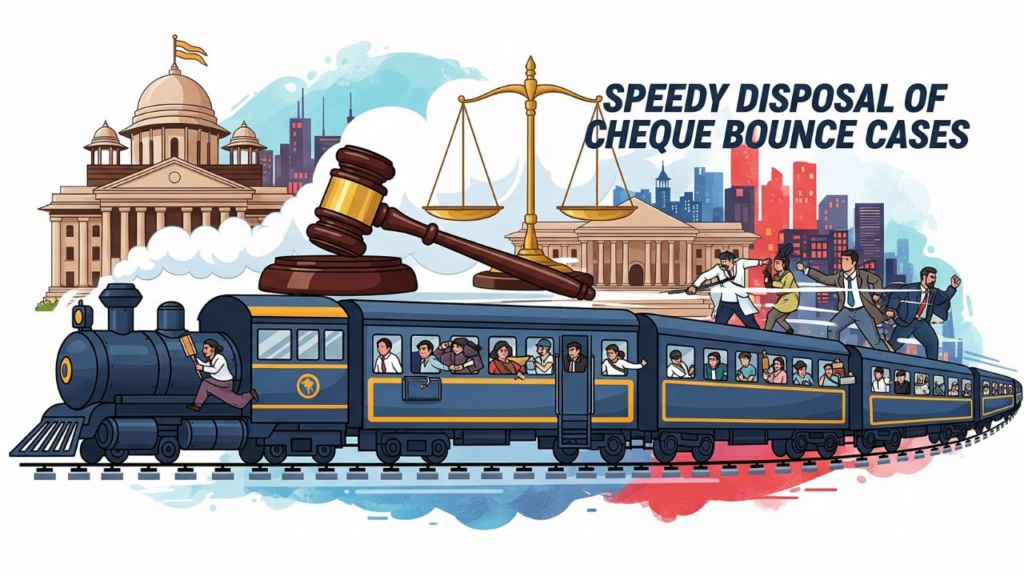
With a report of 3.3 million cheque bounce cases pending, Supreme Court has responded with a plan of action to establish 25 special courts as part of pilot project to look into such pending cases.
Special courts will be presided by retired staff in the last five years or so and will handle cases pending in the states of Maharashtra, Rajasthan, Gujarat, Delhi, and Uttar Pradesh. Tenure of pilot project is one year from September 1, 2022 to August 31, 2023.
The pilot study shall be conducted in 25 special courts in total. Each five districts with high pendency of cases will have a special court dedicated to adjudicate such pending cases. Underlying intent is to expand the process to entire nation based on evaluation and outcome of pilot project. Special courts will conduct trial as per procedures established under Criminal Procedure Code, 1973.
Major process aspect is that special courts will only handle and adjudicate cases wherein accused has appeared in court (self or via a lawyer) with proper issuance of summons. Another noteworthy aspect is that cases will be sorted out in a chronological order based on criteria wherein issuance of summons is completed.
Special courts will not entertain cases wherein summons process is incomplete – no such cases will be forwarded to special courts for adjudication.
Two critical process measures will be adopted to make certain cases are adjudicated and disposed off quickly, namely as follows:
a) No routine adjournment of cases
b) Electronic examination of outstation witnesses subject to applicable protocol to ensure process is not delayed on pretext of traveling from outstation to courts.
It is anticipated that this pilot project will provide much needed relief and justice in quick time to aggrieved people involved in such cheque bounce cases. This pilot project reflects commitment of Supreme Court in delivering relief to aggrieved parties in a timely manner without any undue delay.
This pilot project is one of its kind and definitely a step in right direction to streamline adjudication process to quickly resolve cases – Based on success of this project, it could be expanded to other stream of cases as well.
