
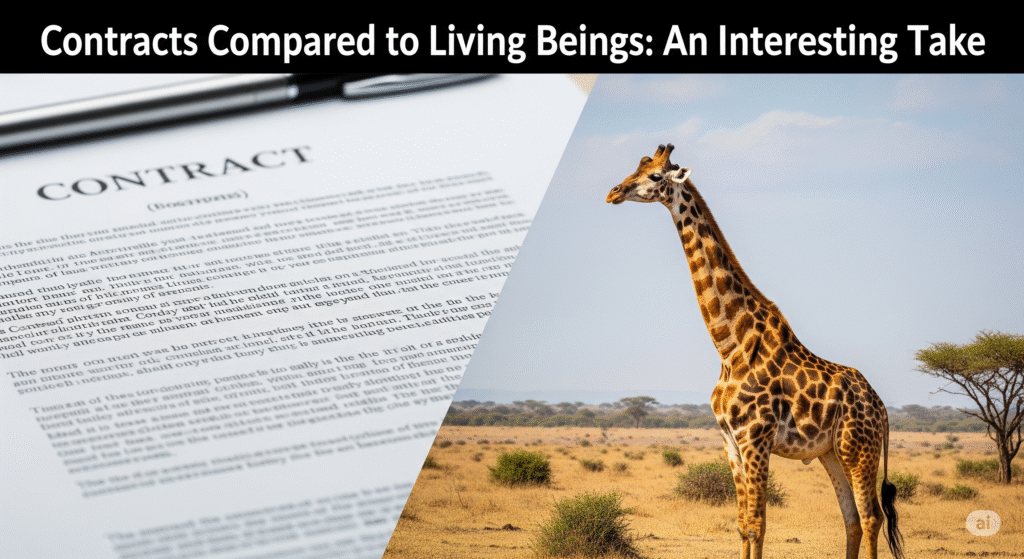
Did you ever think contracts are dull, boring and ‘dead’ formal documents executed for the sake of legal standing and enforceability?
Let’s take a new interesting take comparing contracts to living beings.
Yes, we can draw some interesting comparisons between contracts and living beings, especially in terms of their functions, characteristics, and processes. Here are a few points of comparison:
Formation and Growth
Just as living beings are born and grow, contracts are created and can evolve. A contract is formed when parties agree on terms, much like how a living organism comes into existence and develops over time. Contracts can also adapt or change through amendments, similar to how living beings adapt to their environments.
Lifecycle
Contracts have a lifecycle: they are negotiated, executed, fulfilled, and eventually they may terminate or expire. This can be compared to the lifecycle of living beings, which includes birth, growth, reproduction, and death.
Interdependence
Just as living beings often rely on other organisms and their environment to survive, contracts often depend on the relationship between the parties involved and external conditions, like laws and regulations.
Integrity and Health
The effectiveness of a contract can be seen as its “health.” A well-structured, clear contract can function effectively (like a healthy organism), while a poorly written contract can lead to disputes and legal issues (similar to a living being suffering from disease or dysfunction).
Flexibility and Resilience
Some contracts are designed to be flexible and can withstand changes in circumstances, akin to how some organisms can adapt to new environments. Others might be rigid and break down under stress, just like some species can be fragile and susceptible to environmental changes.
Termination
Contracts can terminate through various means, such as mutual agreement or fulfilment of conditions, just as living beings face natural ends to their lives. However, contracts can also have a legacy through their implications and effects, just as the impact of an organism can continue after its death.
Communication
Organisms communicate through various means (verbal, chemical signals, body language, etc.) to ensure survival and maintain relationships. Similarly, good contracts incorporate clear communication of terms, conditions, and intentions among parties. Miscommunication, like misunderstandings in a contract, can lead to disputes or breakdowns in the relationship.
Compliance and Adaptation
Living beings must comply with their environment (e.g., adapting to climate, finding food sources) to thrive. Contracts also must comply with laws, regulations, and the evolving context of the parties involved. The ability of contracts to adapt to changes or unforeseen circumstances can be likened to the adaptive capabilities of living organisms.
Ownership and Rights
Just as living beings can claim territories or resources, contracts define ownership and rights among parties. They establish who has rights to certain actions, assets, or outcomes, similar to how organisms compete for and claim resources in their ecosystems.
Diversity
In nature, biodiversity leads to resilience within ecosystems. Likewise, contracts come in various forms (e.g., leases, employment agreements, sales contracts). This diversity allows legal systems to address a wide range of situations, ensuring that different needs are met in business and personal dealings.
Conflict and Resolution Mechanisms
Living beings often encounter conflicts and competition for resources, which necessitates mechanisms for resolution (e.g., fighting, fleeing, adapting). Contracts also have built-in mechanisms for resolving disputes, such as mediation, arbitration, or litigation. This aspect highlights the importance of identifying and resolving issues to maintain harmony.
Regeneration
Some organisms can regenerate lost parts (like certain reptiles and starfish). Similarly, contracts can be “regenerated” or restored through renegotiation or modification after a breach or misunderstanding, indicating resilience and the potential for renewal.
Nurturing Relationships
Just as living beings depend on nurturing relationships for growth and support (e.g., parent-offspring relationships or symbiotic relationships), contracts often hinge on the ongoing relationship between the parties involved. Strong, healthy relationships can lead to the successful performance and fulfilment of contractual obligations.
Inherent Risks
Living beings face inherent risks (e.g., predators, disease, environmental changes) that threaten their survival. Contracts also carry risks, such as non-performance, misunderstandings, or changes in circumstances that can affect obligations, highlighting the importance of risk management in both areas.
Evolution and Legal Doctrine
Living organisms evolve over time through natural selection, adapting to their environments. Contracts, too, evolve through case law and legal doctrines, as courts interpret and refine the principles behind contract law. This evolution reflects changes in society, market conditions, and legal standards.
Vital Signs and Health Checks
Just as doctors monitor the health of living beings through vital signs and check-ups, parties to a contract should monitor compliance and performance. Regular reviews of contracts can prevent issues and ensure that the agreement remains “healthy” and aligns with the parties’ interests.
Contracts are like pets: they need constant care, clear boundaries, and a lot of attention, or else they’ll turn into a messy situation you never saw coming.
While these comparisons are metaphorical, they help illustrate certain aspects of contracts in an engaging way. Ultimately, the functions and complexities of contracts can be likened to many characteristics found in living beings, highlighting the dynamic and interconnected nature of both concepts. These comparisons can provide a richer understanding of the nature of contracts, emphasising their dynamic, complex, and interdependent qualities akin to living beings in an ecological framework.
Do you find contracts a bit more interesting now?
