
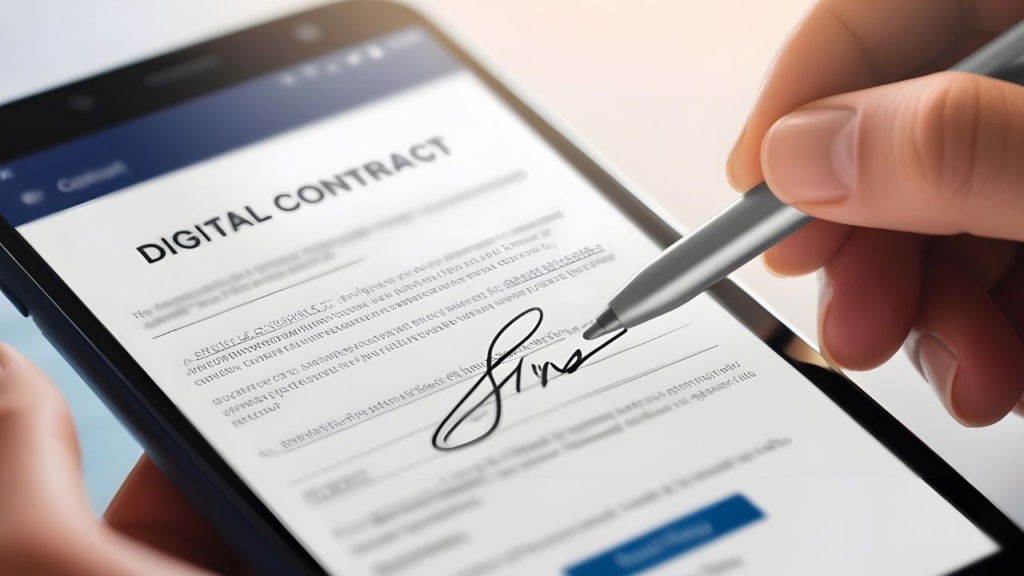
Contracts that are not paper-based and are electronic in nature are known as E-Contracts. These contracts are usually made for the convenience of the parties or to speed up the process of entering into a contract.[1] They are usually formed between parties that live in two distant corners of the world and must reach an agreement.[2] Even if both parties to the contract are sitting thousands of miles apart, all they need is a digital signature to enter into an E-contract[3].
It is the easiest means of entering into a contract without being physically present in the required geographical location, in today’s world. The Originator and the Addressee are the two main participants in an e-contract.[4]
With the rapid advancement of information technology, it is becoming increasingly simple to engage in electronic contracts for business transactions. It is possible to enter into such a contract immediately by exchanging electronic communication of offer and acceptance between the parties.[5]
We all enter into E-contracts on a daily basis, for example, to purchase groceries, books, vegetables, clothing, travel booking, Airlines, and railway tickets, playing games, watching online movies, hiring a cab, and so on[6]. As a result, we have become highly accustomed and connected to the E-contracts. E-contract has the same definition as a traditional contract (paper-based contract) as per the Indian Contract Act, namely, “Contract as an agreement enforceable by law.”[7]
The main difference is that it is carried out through an online means of communication rather than the parties meeting in person. The parties can communicate electronically to construct the contract using a variety of methods, including e-mail, computer software, or two electronic agents configured to identify the formation of the contract[8].
E contracts are becoming increasingly important in our lives as the economy is becoming more technologically advanced and international[9]. E contracts are simple to use and do not require the time-consuming technique used in physical documents contracts[10]. In E-Contracts, paperwork has been significantly minimised. In comparison to the physical contracting system, it is easy to state that the E-Contracts regime is simpler and easier[11].
The UNCITRAL Model Law on Electronic commerce state that “a contract can be made by exchanging data messages and when a data message is used in the formation of a contract, the validity of such contract should not be denied.”[12] The usage of electronic and paper-based communication receives equal legal treatment under model law[13].
The Shift from Traditional Contracts to E-Contracts:
It is observed that the value and prevalence of paper-based contracts have been reduced to a bare minimum in today’s world. The reason behind this shift is the innumerable benefits that E-contracts offer and the increase in E-commerce and online business[14]. Contracts were written on a sheet of paper and signed by the parties involved in earlier times when society was less complex. In the context of a dispute between parties, the paper itself was regarded as solid evidence as the parties felt themselves to be bound by it[15]. The nature of the business was likewise rather straightforward.
The rules governing offer and acceptance, consensus ad idem, acceptance, dispatch location, terms and conditions, and laws governing contract breach have evolved and shaped in response to societal developments[16]. With the difficulties of commercial agreements in the technological age, the framework of traditional contracts has gradually transformed[17]. Furthermore, the evolution of online contracts in the field of e-Commerce is displacing the same[18].
The current business complexities, tax regimes, and legal norms of interpretation have transformed contract settings, resulting in a greater desire for electronic contracts.[19] As a result, the entire world recognises and accepts these unique sorts of contracts as the equivalent of paper-based contracts. An electronic contract is ideally adapted to and meets the needs of the business.[20]
[17] Id.
